
 The uncomfortable truth is that Western luxury has quietly relied on Indian craftsmanship for generations. Image credit: Shutterstock
By Abhay Gupta
Every few years, a great Western luxury house holds its breath. A creative director departs, and the market begins to price the risk that the soul of the house has left with the person.
That moment is not an accident at the edges of the model. It is the model’s central bet.
The maison concentrates irreplaceable value in a single human being and then spends decades and extraordinary sums managing the risk it created at the outset.
“Building the Shilp-Griha: The Operating Model for India’s Houses of Craft,” the fourth paper in the Luxury Connect Strategy Series, argues that India’s emerging luxury houses have a rare opportunity to refuse that bet by design.
Why India’s houses face a different choice
India has the raw material for a luxury industry of global consequence. Its handicraft exports were about $3.7 billion in 2022–23. Swiss watch exports alone were about Swiss Francs CHF 26.7 billion in 2023, close to eight times as much.
The difference does not reflect a lack of skill among India’s 7 million artisans. It reflects a lack of institutions.
Because India’s houses are still being built, their founders can choose their structure.
A house built around one person’s eye has no alternative to the maison’s bet. A house built around a craft lineage does, and for such a house the paper argues that the bet is the wrong one.
The Shilp-Griha: value held by the institution
The paper calls the alternative the Shilp-Griha, a house of craft with the master artisan, or Shilpi, at its center. Its enduring value sits in four assets: the secured craft lineage, the network of master artisans, the codified narrative of the house and the Icon those hands produce.
That icon is a product so complete that it remains unmistakably the house’s own with every logo removed.
All four can be transmitted across generations. None of them walks out of the door when one person does.
3 structural choices that make continuity real
The paper sets out three choices that turn continuity from a hope into a feature.
The first is to institutionalize the craft, not the founder.
The knowledge that makes the house is held, documented and transmitted across the artisan network, so that the core competence does not leave when any individual does.
The founder is the catalyst, not the container.
The second is to codify the lineage.
Provenance, technique and narrative are recorded as institutional property rather than carried only in living memory. What is written down survives, while what lives in one head is a single point of failure.
The third is to separate the creative office from ownership of the intellectual property.
Creative leadership can change hands without the house losing control of the lineage, the narrative or the icon that constitute its real value.
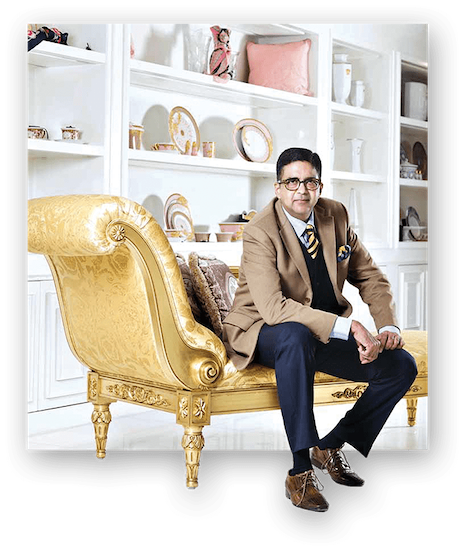 Abhay Gupta
The decision that makes the rest possible
Continuity depends on one earlier decision, which the paper treats as the most important in the entire model.
In most Indian luxury supply chains, the master artisan is a piece-rate vendor.
A house that keeps him there is renting its own intellectual property, and it can be out-bid for that property by any competitor willing to pay more for the same hands.
In a Shilp-Griha, the artisan becomes a compensated stakeholder and the guardian of the house’s intellectual property. That is what secures the lineage on which every later stage depends.
The paper then describes how such a house is run. It needs a luxury orchestrator fluent in both the boardroom and the workshop, and three disciplines: its own calendar, exacting quality and a point of sale that shows the making. It is built in a fixed sequence, and the founder who installs succession in the first year rather than the last is the one whose house endures.
Why this matters to investors
For anyone who has watched succession play out as existential drama across the great houses, the proposition is pointed. An asset that does not evaporate when one person leaves is an asset a serious investor can underwrite.
The paper’s framework suggests four questions an investor might put to any Indian luxury founder:
- Is the craft lineage secured on terms that make the house the artisans’ best home?
- Are the master artisans stakeholders, or suppliers who could be hired away tomorrow?
- Does the house own its intellectual property separately from whoever holds the creative office?
- Does the house measure whether it is becoming an institution, or only whether it is growing?
A founder with clear answers to all four is building a house. A founder without them is building a biography.
Built to last
The Western house has given the world a template for luxury, and it remains a magnificent one.
India now has an older template, and the paper argues that it is also more durable. It is built around a craft rather than a person, and it is designed from the outset to outlast whoever has the conviction to begin it.
Sources: Export Promotion Council for Handicrafts, FY2022–23 export figures; Federation of the Swiss Watch Industry, 2023 export statistics.
Abhay Gupta is founder and chairman of Luxury Connect and Luxury Connect Business School, Gurgaon, Haryana, India. He is a columnist for Luxury Marketer and author of “The Incredible Indian Luxury Bazaar.” Reach him at [email protected].