
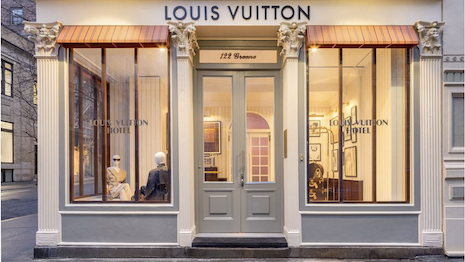
 Louis Vuitton Hotel pop-up store in New York's SoHo district to mark the 130th anniversary of the LV Monogram. Image credit: Louis Vuitton
Dior on a beach in Ibiza.
Louis Vuitton taking over a hotel in Saint-Tropez.
Chanel turning a Beijing plaza into a working radio station.
Jacquemus once again at the Monte Carlo Beach in Monaco.
The list could go on ...
The pop-up is no longer a "test." It's now a pillar of luxury distribution strategy.
Three forces explain it.
First, scarcity as an asset. The pop-up reintroduces the constraint of time and place: here, now, or never. It doesn't manufacture availability – it manufactures desirable tension.
Next, transaction gives way to experience. A pop-up delivers what a permanent store delivers poorly: media attention, organic reach and fresh customer data. The product becomes secondary — what's sold is the context.
Finally, light capital vs. heavy real estate. A prime-avenue store locks up capital for a decade. A pop-up is optionality: test a market, a season, a clientele, without committing the balance sheet. You go where the affluent customer already is, you follow.
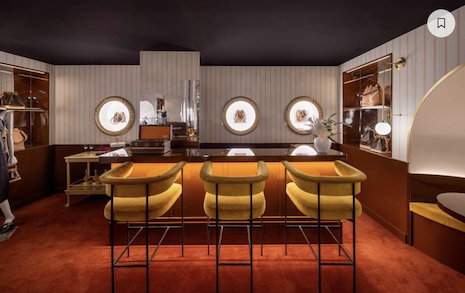 Louis Vuitton's pop-up store in New York's SoHo district earlier this year. Image credit: Louis Vuitton
But here's what most brands underestimate: a pop-up raises the experience bar – it doesn't lower it.
Because the format is temporary, customers expect it to be extraordinary.
The best activations make the experience the product.
An ephemeral space concentrates the entire brand into a few weeks and a few square meters.
So, the discipline is crucial: flagship-caliber staff, a narrative thread from door to checkout, service at its best.
The pop-up isn't a lighter version of the boutique — it's the most demanding one.
What this tells us: distribution is evolving, fast.
The same houses are consolidating into fewer, larger flagships and using pop-ups to create scarcity. Ephemeral to attract, permanent to retain. Two speeds, one standard.
THE REAL QUESTION for a leader isn't, "Should we do a pop-up?"
It's this poser: Does my distribution still tell a coherent story — and can I deliver it perfectly everywhere?
 Christophe Caïs
Christophe Caïs is CEO of CXG, Dubai. Reach him at [email protected].