
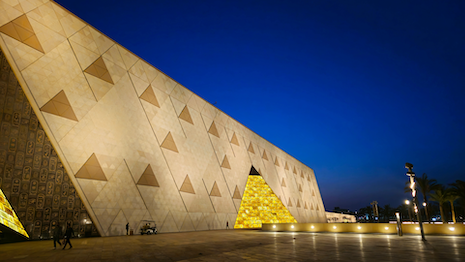
 Exterior of the Grand Egyptian Museum in Giza outside Cairo. Image credit: Shutterstock, Tamer A. Soliman
Today’s headlines are replete with bad news. Tariffs are in a state of flux and adversely affect importing and exporting, pricing and consumer sentiment.
There is a war in Iran that is stalling business in the Strait of Hormuz, halting commerce in the Persian Gulf and Gulf of Oman.
Luxury brands that want to move their merchandise by sea through Kuwait, Bahrain, Qatar, United Arab Emirates and parts of Oman are stuck.
Safe house
While there is some active commerce, insurance companies have changed insurance policies to eliminate insurance of containers moving through the Strait of Hormuz.
Now, insurers require pre-approval of all shipments by the insurance carrier before the shipment is covered against loss or other injury. The result? Dubai, once the center of luxury commerce in Arabic-speaking countries, is now in the rear-view mirror.
Interestingly, Egypt, previously-hailed as one of the cradles of civilization and proponent of peace politics, seems forgotten, even abandoned by the luxury market.
However, Egypt is likely the safest and most profit-driven country for luxury brands in the Arabic-speaking world.
Although the region itself is rife with conflict, wars, corruption and other things that should not be overlooked, Egypt is likely the safest place in the region. Here’s why:
- Egypt is a peace broker. It acts as a crucial mediator in Middle East peace, particularly in Gaza. It plays a key role in negotiating ceasefires, advancing reconstruction, securing borders, and maintained its promises pursuant to a 1979 peace treaty with Israel.
- Egypt is seeking to avoid a regional war and is central to the nuclear talks between Iran and the United States.
- Egypt is supporting its neighbors in Libya and Sudan to contain and manage the current conflict.
- While not immune to war, Egypt’s monuments are respected. The Great Pyramids, Valley of the Kings, Abu Simbel Temples and The Mortuary Temple of Hatshepsut.
 Rania V. Sedhom
Trade grade
Egypt’s economy is growing. The IMF is optimistic about Egypt and stated that it is in a “genuine recovery phase.”
Egypt reduced its inflation rate, expanded its GDP by more than 5 percent and is focusing on strengthening the private sector. Egypt is not putting all of its eggs in the proverbial basket. Instead, it is scaling non-oil manufacturing, tourism and Suez Canal activity.
In its own words, Egypt declared that the Suez Canal is “at the heart of the global trade route” with seven ports available for transportation.
Rather than have products stuck in the Strait of Hormuz, luxury brands can consider several paths to get their products throughout the Arabic-speaking world, Asia and Europe with little headaches.
In addition to frictionless transportation, Egypt also has the infrastructure for manufacturing textiles, automotive and water transportation parts, cosmetics and apothecary, and has available data centers and communication equipment for the ready.
Old is new
While Dubai has created a city that the world marvels – new buildings, artificial islands shaped liked palm trees, ice skating rink in a mall and other experiences – Egypt continues to maintain historical landmarks, one of the seven wonders of the world, exclusive, five-star resorts, five-star neighborhoods and the largest concentration of wealth in Africa.
Egypt has advantageous tax and investment incentives for companies in specified regions.
Some brands such as Bulgari and Saint Laurent already have stores in Cairo. This is no surprise, as Egypt is a destination and home to the well-heeled.
Egypt is modernizing fast. It is putting hundreds of millions of dollars into creating new commercial hubs with luxury accommodations. It created New Cairo, which houses the Cairo Design District with local and world-renowned brands such as Okhtein and Temraza as well as international fashion houses including Dior and Sandro.
Egypt also attracts tourists with money to spend, searching for luxury experiences and shopping at Sharm-El-Sheikh, Marsa Matrouh and El Gouna.
The Grand Egyptian Museum, The Egyptian Library, The Citadel of Fort Qaitbey in Alexandria and the Montaza Palace keeps the upper middle class, HENRYs and influencers staying home and inspiring tourists to see what Cairo and Alexandria have to offer.
EGYPT CREATES A unique and stable opportunity for luxury brands for manufacturing, logistics and retail establishments.
Luxury brands may benefit greatly from setting their sights on Egypt.
Remember, the world’s oldest luxury goods were produced in Egypt and those pieces are housed in museums worldwide. Why not consider going straight to the source?
Rania Sedhom is managing partner of the Sedhom Law Group, New York. Reach her at [email protected].