
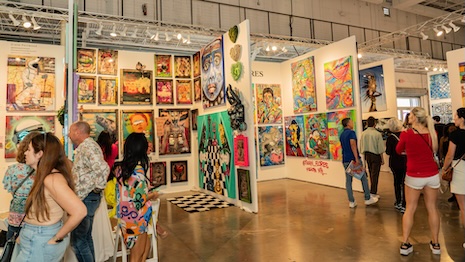
Art Basel Miami at the Wynwood Convention Center in Miami, December 2023. Image credit: Shutterstock
Global sales of art grew by 4 percent year-on year to an estimated $59.6 billion in 2025 after two years of declining values, with an increase in aggregate sales across both the dealer and public auction sectors.
The United States, United Kingdom and China accounted for 76 percent of global art sales by value, with each market reporting growth driven predominantly by auctions. The findings were part of the 10th annual Art Basel and UBS Art Market Report 2026 authored by Arts Economics founder Clare McAndrew.
“While still below its 2022 peak, the market regained stability, responding to a demanding and increasingly complex global landscape,” said Noah Horowitz, CEO of Art Basel, in the report.
“[The report’s] findings point to recovery, but also evolution, as the market navigates geopolitical volatility, tariffs and shifting patterns of demand. Gains in 2025 were driven by renewed confidence in the second half of the year and strength at the high end, in particular,” he said.
Meaningful progress in the representation of female artists
Female artist representation strengthened further in 2025, reaching 50 percent among primary market galleries and 45 percent across all dealers.
Works by female artists accounted for 37 percent of sales by value, up from 28 percent in 2018, although disparities persist at the highest revenue levels.
Increasing importance of art fairs
While online sales declined, art fair sales increased by 4 percent year-on-year to 35 percent of dealer turnover, reaching their highest level since 2022.
Improving outlook
Confidence strengthened heading into 2026, with 43 percent of dealers expecting sales to improve and 38 percent anticipating stable performance.
“The art market has entered 2026 optimistically, following strong autumn and winter fairs, record‑breaking auction results and broadening collecting interests that have helped stabilize sentiment,” said Christl Novakovic, head of UBS Global Wealth Management for EMEA, chair of the UBS Art Board UBS and global lead partner of Art Basel, in the report.
“Although these developments are encouraging, it is not yet clear whether they will lead to healthier, more sustainable levels of activity,” she said. “Every year brings new forces that shape our world and the markets within.”
Excerpts from the report:
The global art market: Key findings
- The global art market returned to growth in 2025, with sales increasing by 4 percent year-on-year to an estimated $59.6 billion. While this marked a welcome shift in the direction of the market following two consecutive years of declining values, the recovery was moderate and uneven, leaving the market below its 2022 peak.
- Aggregate sales in the dealer and public auction markets both improved in 2025. Public auction sales showed the biggest uplift year-on-year, rising 9 percent in value after a sharp contraction in 2024, while the dealer sector rose by just 2 percent. In contrast, private sales at auction houses declined by 5 percent. This reversed the pattern of 2024, when public auction sales declined and private sales increased.
- Transaction volume remained broadly stable in 2025, rising just 2 percent year-on-year to 41.5 million. In 2024, lower-priced segments had driven growth despite declining values; in 2025, growth in total transactions was more muted, as dealer volumes edged higher while auction volumes eased slightly.
- The U.S., U.K. and China accounted for 76 percent of global sales, stable year-on-year. The U.S. maintained its position as the leading art market worldwide, accounting for 44 percent of global sales by value, up 1 percent year-on-year. The U.K. was the second-largest market with a stable share of 18 percent, while China remained third with 14 percent.
- Sales in the U.S. reached $26 billion in 2025, growing 5 percent year-on-year, following two years of decline. Although 2025 was marked by trade policy unpredictability, high-end sales returned to growth. The combined value of fine art works sold at auction for over $10 million increased by nearly 40 percent in the U.S.. While high-value sales helped the market return to a positive trajectory, sales were still below their peak in 2022 and pre-pandemic 2019 levels.
- Policy unpredictability associated with the Trump administration in 2025 – particularly in relation to tariffs – was a significant concern for the art trade in the U.S. and globally. Imports of art and antiques to the U.S., which fuel some of the major sales, rose by 13 percent in value in 2025 to $9.9 billion, while exports fell by 1 percent. Some of the disruptive effects of tariffs were mitigated by exemptions, policy reversals and anticipatory moves to stockpile imports, although many dealers and auction houses noted negative direct and indirect impacts on their businesses in 2025.
- Sales in the U.K. reached $10.5 billion in 2025, up 2 percent from 2024. While public auction sales grew, dealer sales were more subdued, keeping the overall growth rate to a modest 2 percent, with total sales still below those achieved in 2019.
- Sales in China were stable, increasing by just over 1 percent to $8.5 billion. Auction sales picked up in the largely domestically focused Mainland China market, while the more internationally oriented market in Hong Kong contracted. In Asian markets outside China, growth was also mixed. Japan – which had bucked the declining trend in 2024 – had a slower year of sales, with values down by 1 percent in 2025, while South Korea posted gains of 6 percent.
- In France – the fourth-largest market worldwide – sales reached $4.5 billion, up 9 percent year-on-year and bringing values just above their 2019 level. Performance elsewhere in Europe was mixed, with growth in Switzerland (up 13 percent), Austria (up 13 percent) and Spain (up 6 percent), while the German and Italian markets slowed (down 10 percent and 2 percent, respectively).
- In 2025, online sales fell to $9.2 billion, their lowest level since 2019. Dealers reported a significant drop in the share of their sales made through exclusively digital channels, and auction house online-only sales were focused on mid- and lower-price levels, while the highest-priced lots were sold in live sales. As high-end offline sales regained momentum, the share of online-only sales fell 3 percent year-on-year to 15 percent of total art market sales. This was down 10 percent from its peak of 25 percent in 2020 but remained above the pre-pandemic level of 9 percent in 2019.
A conversation with Clare McAndrew, founder of Arts Economics, on 10 years of partnership, her research process and the craft of interpreting the global art market:
Clare McAndrew on the craft of art market research: 10 years of Art Basel and UBS
This year, 2026, marks the 10th anniversary of the Art Basel and UBS Art Market Report, researched and written by Dr. Clare McAndrew, founder of Arts Economics.
Each year, the report analyses the global art market across key market segments, including galleries and dealers, auction houses and art fairs, along with buyer behavior, global wealth changes and ever-changing economic conditions.
UBS asked Dr. McAndrew about what has changed during her decade behind the scenes of the most comprehensive data-driven overview of the art market.
How has the Art Market Report evolved since the first edition, and what major shifts have you observed over the past decade?
It has been a truly fascinating time to observe and record the market, with more changes in the last 20 years than possibly 100 years before that.
The market has obviously grown a lot in size, and a big part of that has been its increasing global diversity.
In the 1980s and 1990s, the vast majority of art sales were concentrated in the U.S. and Europe. But from the early 2000s onwards, the expansion in Asia — particularly the rapid growth of the Chinese market — really changed both the structure and the scale of the market.
So today I’m measuring sales and activity across a much wider range of markets than I was 10 or 20 years ago.
The way sales are made has also shifted quite fundamentally.
In the past, auction houses operated more like wholesalers to dealers, whereas now both auctions and galleries are active in direct and private sales.
It has been amazing to watch and chart the rise of a much more event‑driven market, with major art fairs becoming key moments in the sales cycle and central to how many galleries do business. And, more recently, particularly since the pandemic, there’s been a big increase in ecommerce.
What initially drew you to analyzing the art market, and what continues to motivate you in this work?
Another part of the evolution has been the kinds of data we can access.
While there have been improvements in the availability of data in some areas, and in the tools and metrics we have to collect and analyze it, a lot of the information that’s needed to properly measure the art market still sits in the private sphere.
Because of that, a large share of the data in the report comes from original, primary research that I carry out each year through surveys, interviews and other direct conversations with people working in the market.
That does make the research more complex to compile, because it always requires a human element, and trying to get an understanding of the context behind the numbers. But in many ways, that’s also what makes it the most interesting and rewarding part of the work for me personally.
Ultimately, good research isn’t just about the data — it’s also about asking the right questions.
The art trade needs and appreciates access to these industry‑wide statistics, whether it’s to help them in benchmarking their performance, encourage new buyers or support the industry.
The reports started out as a means to provide the trade with key industry stats they could use to inform stakeholders who needed answers on things like market size, employment and economic impact.
I’ve had some helpful feedback over the years from the auction houses, dealers, gallery associations and others about the kind of information they really need, so we’re always trying to keep it relevant and useful.
If you could highlight one misconception people often have about the art market, what would it be?
I think one of the biggest is that you need to spend a lot of money to be involved in the art market or to buy something really “good.” This is perpetuated a bit by the fact that most or all of what the media reports on is the multi-million-dollar sums paid for a small number of really high-priced artists.
New buyers are led to believe that the art market is out of their reach, and that you can only get a quality work of art if you have a budget of over $1 million, for example, when in fact there are still so many other less publicized artists and works available at much lower prices.
It’s actually a really democratic market with a place for so many different interests, tastes and budgets.
The reality is that despite the amount of attention the very top of the market gets, most transactions and the day-to-day business of most businesses in the art market are at much lower prices: less than 0.5 percent of the transactions at fine art auctions last year were for prices over $1 million and 95 percent were less than $50,000, including 77 percent for less than $5,000.
