
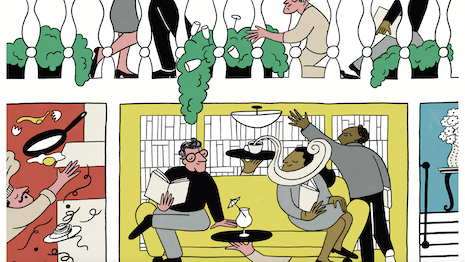
‘Be more like a private members’ club’ appears to be the answer to all sorts of real estate’s most pressing questions
Forbes, a name more associated with a magazine – and a licensed real estate network – this week opened a private members’ club in the Spanish capital of Madrid in a brand-diversification move.
Located in the city’s financial district, Forbes House Madrid will target business executives and entrepreneurs, eyeing a market long held by Britain’s Soho House.
In the report excerpted below, British real estate firm Knight Frank outlines why private members’ clubs are one of the brightest spots for real estate as the number of affluent and wealthy individuals worldwide grows exponentially.
According to market researcher Mordor Intelligence, the private members’ club sector globally will grow annually at 11 percent through 2027 to reach $25.8 billion in value.
That anticipated growth indicates a healthy appetite for the wealthy who seek to hobnob with their peers in secluded corners, enjoyed food, wine and conversation without the presence of hoi polloi.
However, private members’ clubs are not as easy to put together, as Knight Frank explains in its report.
More private members’ clubs have opened in the past four years than during the three decades following the opening of The Groucho Club in London.
Knight Frank’s new guide pulls back the curtain on a big-money business transforming the hospitality sector. Knight Frank head of global research Liam Bailey and researcher Patrick Gower authored the report.
Here, in the words of Messrs. Bailey and Gower, is the introduction:
A rising sector with big implications for real estate
It’s hard to know exactly why private members’ clubs have quietly become one of the fastest-growing subsectors in the real estate industry.
Some say it’s a desire for connection and community in a world of frenetic activity. Others suggest it’s all about exclusivity and bragging rights.
Whatever the truth, the effects are far-reaching.
More clubs have opened in the past four years than in the three decades following the 1985 opening of The Groucho Club.
The pipeline of prospective openings is the largest it has ever been—a fact confirmed by Knight Frank Private Office partners Alasdair Pritchard and Hugh Dixon, who are busy scouring Europe and the United States for locations on behalf of prospective club owners.
The implications for real estate owners of all types are numerous.
Consider the sectors in the midst of transformations.
Office architects pore over plans to ensure developments are amenity-rich with plenty of serendipitous meeting points and nooks and crannies for private conversations.
Retailers are still seeking ways to move from purely transactional spaces to more immersive experiences.
Hoteliers are looking for new ways to create deeper relationships with guests to increase loyalty.
‘Be more like a private members’ club’ appears to be the answer to all sorts of real estate’s most pressing questions.
Indeed, the ‘big glass box’ approach to real estate appears increasingly weak.
Jan Garde, founder of The Embassies, told us (p.10) that it is a mistake is to approach things from a perspective of ‘Hey, we’ve got a building, what should we do with it’, rather than ‘Hey, we’ve got a consumer, how do we market to them?’”
This isn’t just a commercial story, either.
Types of clubs have proliferated, but two of the most interesting are super-luxurious clubs such as Aman, in New York, and hyper-local clubs including Inness in upstate New York and The Dally in London’s Islington.
While centrally-located big-brand clubs are city-wide resources, the latter local model is already influencing house prices.
The impact on property values can be significant when the clubs come with luxury facilities.
The world’s ultimate neighborhood club cluster is in England’s Cotswolds, comprising Estelle Manor, The Club by Bamford and Soho Farmhouse. Our research confirms that residential vendors will try to sprinkle a little stardust due to their proximity to these clubs, often mentioning them in their sales particulars even when they are up to 60 miles away.
The reasons why are clear: our data shows that in August 2024, demand for properties within 15 minutes drive of Soho Farmhouse was running at more than twice the average for the area, with 2.3 buyers registering for every one buyer in adjacent areas. They are different buyers, too – more international, more affluent.
Typically, 12 percent of buyers registering in the Cotswolds are from outside the United Kingdom, but that rises to 26 percent within the all-important 15-minute drive to Soho Farmhouse.
Not only that, but houses within a mile of these clubs sell faster (by 2.5 weeks) compared to similar properties five miles further away.
One of the many important questions for clubs is how they capture the external value they create. Their presence can add glamour to a destination, bolstering local retail, restaurants and hotels.
As a result, clubs owners are increasingly looking to define and capture this uplift during rental negotiations, Mr. Pritchard told us while preparing this report.
Soho House pioneered much of this. The company is happy to leverage the brand when dealing with partners in new markets, often collaborating with local property owners to create buildings that align with the brand, rather than purchasing buildings itself.
Others will surely catch on, so whether you’re in commercial real estate or a homeowner, this report is for you.
The world of private members’ clubs is, by nature, private, and the secrets to success are as closely guarded as the guest lists.
However, by interviewing more than a dozen club owners, industry insiders and Knight Frank experts, we pull back the curtain on a big-money business that is transforming the hospitality sector.
Even if we can’t know exactly why.
Please click or tap here to download Knight Frank’s ‘A Guide to Private Members’ Clubs’
