
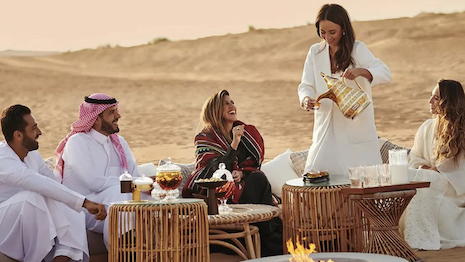
Tanagra is part of Middle Eastern luxury retail giant Chalhoub Group's portfolio of brands. Image: Chalhoub Group
Estimated at $480 million to $500 million in 2022, the luxury re-commerce market in the Gulf Cooperation Council countries – Saudi Arabia, United Arab Emirates, Qatar, Bahrain, Kuwait and Oman – is expected to grow at a compound annual growth rate (CAGR) of 10 percent to 15 percent, reaching $760 million to $780 million by 2026.
The estimate from Dubai-based luxury retail conglomerate Chalhoub Group is part of its comprehensive circularity report, titled ‘Circular Fashion Potential in the GCC.’ The report is the first of its kind in the region and delves into the evolving landscape of circular fashion while highlighting consumer behavior as well as the potential and growing trends within the luxury re-commerce sector in the GCC.
“Sustainability remains at the heart of our operations and our circularity report is more than an analysis – it reflects our ongoing commitments to embracing more sustainable business models as we aim for our Net Zero target by 2040,” said Patrick Chalhoub, group president of Chalhoub Group, in a statement.
“We will continue to stress the importance of alignment among policy makers, regulators, brands, retailers and customers as we keep our focus at the initiative level driven by interested brands and consumer affinity,” he said.
This pioneering report for the Middle East leveraged desk research and data from publicly available sources, as well as 15 interviews with key players in the ecosystem, along with a proprietary survey of 1,300 consumers across the GCC.
Chalhoub Group owns several retail destinations, represents several luxury brands and even owns its own labels including French silverware maker Christofle.
French silverware and china brand Christofle is part of Middle Eastern luxury retail giant Chalhoub Group's portfolio. Image: Chalhoub Group
Old is new
Per the report, the largest luxury segment in value is watches, accounting for about 50 percent of the market size, followed by jewelry (16 percent), handbags (13 percent), apparel (12 percent) and footwear (10 percent).
Consumers in the six Arab countries show a significant shift towards circularity along all price levels, with one-third of them having already purchased preowned items, and another third planning to do so.
The most sought-after categories that consumers bought in the past 12 months include bags (20 percent), watches (18 percent) and jewelry (16 percent).
The driving factors behind these purchases lead with affordability (43 percent), followed by investment potential (42 percent) and access to limited editions (40 percent), according to the report.
Additionally, 70 percent of consumers stated having resold items in the past year, mainly to make money (42 percent) and finance new purchases (41 percent).
In terms of purchasing channels, online and offline prove to be almost equally important, with 58 percent mainly online purchasers.
For apparel, footwear and bags, peer-to-peer platforms are amongst the top channels of choice, while specialist retailers are chosen for watches.
When it comes to non-purchasers, concerns about authenticity (39 percent) and item conditions (39 percent) represent the top two key barriers to buying preowned items.
Furthermore, GCC consumers seem more inclined to re-sell than to purchase preowned items (31 percent), per the report.
THREE OUT OF four respondents revealed that they have re-sold fashion items in the last year, and a similar number – 73 percent – consider the resale value before purchasing a luxury item.
“Our comprehensive research spanning the entire GCC region underscores the importance of circularity in the fashion sector, an industry which accounts for approximately 10 percent of global CO2 emissions,” said Florence Bulte, Chalhoub’s chief sustainability officer, in a statement.
“By embracing sustainable business models and focusing on circular initiatives, we are responding to the increasing consumer demand, paving the way to Net Zero and actively embedding sustainability into the core of our business,” she said.
Please click or tap here to download the 'Circular Fashion Potential in the GCC' 2023 report
