
- Luxury Marketer - https://www.luxurymarketer.com -

Number of global centi-millionaires with assets north of $100M up 12pc to 28,420

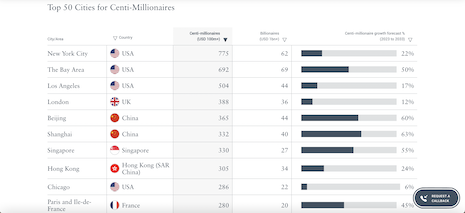
New York is No. 1 among the Top 10 cities for centi-millionaires. Source: New World Wealth, Henley & Partners New York is No. 1 among the Top 10 cities for centi-millionaires. Source: New World Wealth, Henley & Partners


The global number of centi-millionaires – individuals with assets upwards of $100 million – is up by 12 percent this year versus last, per a new study.

An estimated 28,420 centi-millionaires have been identified worldwide by wealth and investment migration advisors Henley & Partners with data from wealth intelligence firm New World Wealth. Indeed, $100 million is now the new minimum for being counted as super-wealthy.

“Not long ago, in the late 1990s, $30 million was considered by most banks as the fortune that was needed to meet this status,” said Juerg Steffen, CEO of Henley & Partners, in the report.

“However, asset prices have risen significantly since then, making $100 million the new benchmark,” he said.

Cent of success
These centi-millionaires are either founders of multinational companies or heirs to vast family fortunes.

One third of the world’s centi-millionaire community live in 50 key cities across the globe.

New York City wears the crown with 775 resident centi-millionaires.

San Francisco’s Bay Area (692), Los Angeles (504), London (388) and Beijing (365) round out the top five cities with the highest number of centi-millionaires worldwide.

THE CENTI-MILLIONAIRE as a barometer of wealth may be more accurate given the paucity of billionaires in many markets outside the First World.

“In a large number of emerging market countries there are very few billionaires, which makes the billionaire wealth band largely irrelevant,” said Andrew Amoils, head of research at New World Wealth, in a statement.

“However, these same countries often have large numbers of centi-millionaires,” he said.

“For instance, Kenya has no billionaires but has 15 centi-millionaires, whilst South Africa has only five billionaires but has 102 centi-millionaires.

“The centi-millionaire wealth band is, therefore, a far more accurate reflection of the “super-wealthy” community in these countries.”


Excerpted below is the opening piece from the Centi-Millionaire Report 2023 written by Juerg Steffen, CEO of Henley & Partners

Centi-Millionaires: A Wealth Band of Affluence and Influence

Just how much money does one need to be considered ‘super-wealthy’ today?

We would argue that to earn that status, the benchmark is holding at least $100 million in investable assets.

Not long ago, in the late 1990s, $30 million was considered the fortune needed to meet this definition. However, asset prices have risen significantly since then, making $100 million the new benchmark.

At Henley & Partners, we refer to this fast-growing global elite of highly influential super-wealthy movers and shakers as ‘centi-millionaires’ or simply ‘centis.’ Their numbers have more than doubled over the past 20 years, and there are currently 28,420 centis in the world, which is 11.5 percent more than there were 12 months ago.

One-third of the world’s centi-millionaires live in 50 key cities across the globe, and almost two-thirds of these centi-millionaire rich cities are in countries with investment migration programs.

Why centi-millionaires matter
Centi-millionaires’ wealth has generally come from four sources: inheritance, selling off their small- to medium-sized enterprises, trading and investing in stock markets, and leading multinationals and highly successful tech companies.

This wealth band is important to track as they are, in many respects, a good reflection and useful barometer when it comes to a country’s private wealth sector.

Many economists consider private wealth to be a better indicator of a jurisdiction’s financial health than GDP, which does not take into account real estate or equity transactions.

What is more, while there may be just a few or even no billionaires in some small countries or emerging markets, these nations can boast a sizable number of centi-millionaires, which is a far more accurate reflection of the power and influence of their ‘super-wealthy’ population as they outnumber billionaires by nearly 10:1 worldwide.

America and the U..K: Home to the Top 4 centi cities
As we outlined in our inaugural Centi-Millionaire Report last year, at a country level, most centi-millionaires are concentrated in the U.S.A., followed by the large emerging markets of China and India.

Certain cities and regions are home to particularly dense centi-millionaire communities, and in our 2023 Centi-Millionaire Report, we reveal the Top 50 cities globally, with the most centi-millionaires.

The U.S.A. takes the top three spots, all of which have over 500 resident centi-millionaires: New York City, which is home to 775 centi-millionaires, the [San Francisco] Bay Area with 692 and Los Angeles with 504.

These leading cities have all grown the size of their centi populations in the past 12 months: New York’s has grown by 5.2 percent and the Bay Area by 11.1 percent, while the number of centi-millionaires in Los Angeles has ballooned by a remarkable 28.2 percent.

Chicago also made it into the Top 10 cities for centis, coming in at ninth place with 286 centi-millionaires, but this is a significant drop of 15.9 percent versus last year for the Windy City.

Overall, the U.S.A. has 12 cities in the Top 50, with a combined total of 3,311 centis, representing 11.7 percent of the world’s centi-millionaire population as of June 2023.

By contrast, the U.K. has only one city in the Top 50, London, which comes in fourth place worldwide with 388 centi-millionaires, representing 1.4 percent of the global centi population.

Once the global center of affluence and influence, London appears to have lost its crown. A year ago, there were 406 centis in the U.K.’s capital city — a loss of 4.4 percent in just 12 months.

Asian cities dominate the Top 10
There is impressive representation from Asia in the upper rankings, with four Asian cities and territories among the world’s Top 10 centi-millionaire hotspots.

Mainland China has two Top 10 cities: Beijing is fifth with 365 centi-millionaires and Shanghai sixth with 332.

Beijing has gained just two centis since last year (0.6 percent) while Shanghai has lost 5.1 percent, dropping from 350 last year and making it the biggest loser in the Top 10 over the past 12 months.

Singapore in seventh place has 330 centis compared to 336 last year, which is a slight drop of 1.2 percent, but still an impressive number of super-wealthy inhabitants considering the geographic smallness of the city-state, which is packing a mighty punch as one of the world’s leading financial centers and wealth hubs.

Hong Kong (SAR China) in eighth place is home to 305 centi-millionaires, up a very healthy 8.9 percent since last year when it had 280.

It is notable that the combined total of China and Hong Kong’s centis in the Top 50 is 1,224, representing 4.3 percent of the world’s centi population, although this is still less than half of the U.S.A.’s headcount.

Paris and Ile-de-France take 10th place in the Top 10 centi cities, boasting 280 resident centi-millionaires between them.

Another nexus for the ultra-wealthy in France, Nice, is also in the Top 50 with 63 centis.

France has 343 centis in the Top 50 cities, representing 1.2 percent of the global centi population.

Centi-millionaire growth forecast to flourish in Global South
Looking at the projected growth in centi-millionaires over the coming decade, it is clear that Asia is going to feature even more prominently on this list in the years ahead.

Of the Top 50 cities, the ecommerce hub of Hangzhou in China is expected to see the highest growth in its centi-millionaire population in the next decade with a projected 95 percent increase, closely followed by the prominent tech hub, Shenzen (88 percent).

The emerging global business center of Riyadh in Saudi Arabia and India’s largest commercial hub, Delhi, are projected to see the third highest growth of 85 percent between now and 2033, while financial capital Mumbai is forecast to enjoy an 80 percent growth in its centi-millionaire community.

Business-friendly Austin in the U.S.A. also has a very strong growth projection of 84 percent by 2033.

Dubai, with its vibrant and diversified economy, is not far behind Mumbai, with centi-millionaire growth of 78 percent projected over the next 10 years, followed by China’s main transport and trading nexus Guangzhou (76 percent) and the multi-business hub of Monaco (72 percent).

The numbers in Australia also look poised to increase sharply — by 67 percent in Melbourne, 60 percent in Sydney and 57 percent in Perth.

By contrast, centi-millionaire growth figures are forecast to be a sluggish 17 percent in Los Angeles, 12 percent in London, 6 percent in Chicago and just 5 percent in Moscow.

Cities and regions with big seasonal variations of centi-millionaires. Source: New World Wealth, Henley & Partners Cities and regions with big seasonal variations of centi-millionaires. Source: New World Wealth, Henley & Partners

Seasonal hotspots for centi-millionaires
With money no object and a penchant for travel, centi-millionaires tend to own multiple properties that they move freely between throughout the year, and certain cities attract them in high numbers during the peak holiday seasons, depending on whether they are seeking sunshine or the slopes.

As our seasonal cities data reveals, major cities such as New York, Los Angeles and London, which are all high up on the list of where centi-millionaires have second homes, see their populations expand even further.

New York’s centi population swells from 775 to over 1,200 at peak times, while Los Angeles’ rises from 504 to over 950, and London’s more than doubles from 388 to over 800.

Prime property in vacation locations is also much sought-after.

In the U.S.A., the Hamptons attracts over 700 centis in season compared to just 30 resident centi-millionaires during the rest of the year.

Miami welcomes over 650 centis in peak season – with just 165 resident centi-millionaires – while Palm Beach and West Palm Beach grow from 60 to over 400 super-wealthy sun-seeking centi-millionaires.

The mountain resorts of Aspen and Jackson Hole are both home to over 200 centis in season compared to just six and eight during the rest of the year, respectively.

On the French Riviera, Nice’s usual 63 centi-millionaires are joined by another 250 or more, rising to a population of over 300, while Portugal’s Golden Triangle in the Algarve surges from 20 to over 250 centis in summer.

More off the beaten track, two African seasonal centi-millionaire hubs are Cape Town, which sees over 100 centis in peak season compared to 25 the rest of the year, and Marrakech, which rises from 10 to over 100, while Bodrum in Türkiye gains over 100 centis compared to the usual eight.


Here is another piece from Rainer Zitelman, an entrepreneur, real estate expert, historian with doctorates in history and sociology and author of 26 books including The Wealth Elite.

The Rich Are Different: Personality Traits of Wealthy People

What does science have to tell us about the personalities of very rich people?

In the past, very little, but now there are a number of studies on the subject that show us what is ‘different’ about the psychology of wealthy people.

Scientific studies
There are plenty of books about how to get rich and the ‘mindset’ of the rich. But these are overwhelmingly mainstream books, rarely scientific studies.

However, in recent years, German scientists, in particular, have become interested in the personality traits of the rich and have been conducting pioneering work in the field.

A team of six economists and psychologists from the universities of Münster, Mainz and Berlin explored the question in greater detail in a large-scale study.

They surveyed 130 rich people to draw up a psychological profile of high-net-worth individuals, which they compared with the population as a whole. Their study was published in 2018.

In another study, published in 2022, scientists from the Socio-Economic Panel (SOEP) at the German Institute for Economic Research and the Westphalian Wilhelms University in Münster compared the personality traits of 1,125 German millionaires with the population as a whole.

The Big Five theory
Of the models used to describe different personality types, the Big Five is the most widely used.

The Big Five model, which distinguishes five personality traits, was also used in the two studies mentioned above. The Big Five theory identifies the following personality traits:

  1. Conscientiousness: This refers to how determined, organized, punctual, persistent and goal-oriented someone is.
  2. Neuroticism: This focuses on a person’s psychological stability — how anxious or insecure are they, how neurotic?
  3. Agreeableness: How concerned is someone with social harmony — or vice versa, how conflict-oriented are they?
  4. Extraversion: How extraverted is a person, how engaged are they with the world around them?
  5. Openness to experience: How people differ in how open they are to new experiences.

The two studies consistently found that rich people are more conscientious, open to experience and extraverted than the average population. They are also less agreeable (that is, less likely to shy away from conflict) and less neurotic (as in, more psychologically stable).

Double-digit millionaires
Methodologically, it is very difficult to form samples with 130 wealthy individuals (per the 2018 study) or 1,125 wealthy respondents (per the 2022 study) — and you have to respect the researchers for being able to do so.

The downside, however, is that the wealth of the respondents in these two studies is predominantly only in the single-digit millions.

But what about the truly rich? By this, I mean people who own financial assets worth at least 10 million euros.

Here, it is impossible to conduct quantitative surveys with representative samples because the group is simply too small.

In social science, researchers distinguish between quantitative and qualitative studies.

Quantitative studies are based on representative samples, while qualitative studies use other methods.

I conducted the first qualitative scientific study on the psychology of the super-rich, namely individuals with a net worth of at least 10 million euros.

I interviewed 45 super-rich individuals, most of whom were worth between 30 million euros and 1 billion euros, some were worth even more.

The Wealth Elite
My study, The Wealth Elite, which was also a doctoral dissertation, differed in depth from the two studies mentioned above: I spoke with each interviewee for between one and two hours, with the transcripts covering 1,700 pages.

I also used a Big Five test, but with far more questions (50 in total).

My study also found that the rich are less agreeable and less neurotic, but more conscientious, more open to experience and more extraverted. Beyond that, however, other key findings emerged in the interviews:

  • The super-rich are overwhelmingly nonconformists who love to swim against the tide.
  • They deal with defeats and setbacks differently than other people — they blame themselves, not others or society at large.
  • There is no correlation between performance at school and university on the one hand and financial success on the other. ‘Implicit learning’ and ‘implicit knowledge’ — or more simply put, gut feeling and intuition — are more important than what psychologists call ‘explicit learning’ and ‘explicit knowledge’ (that is, academic learning).
  • The pursuit of luxury such as expensive cars and mansions is a key driving force for some of the super-rich, but there are just as many for whom this motive is quite irrelevant. Above all, the super-rich are motivated by the pursuit of freedom and independence. They want to decide for themselves whether to work, what work to do, when to work, where to work and with whom they work.

Scientific wealth research is still in its infancy.

In addition to exploring the personality traits of the super-rich, my research also focuses on how the rich are perceived by society.

A representative survey of 11 countries in Europe, Asia and the U.S.A. revealed that continental Europeans – especially the French and Germans – harbor a pronounced sense of social envy against the rich.

In contrast, the Japanese, South Koreans and Vietnamese, in particular, have a very positive image of the rich — whom they regard as role models rather than the targets of envy.

Please click here to read the entire Centi-Millionaire Report 2023