
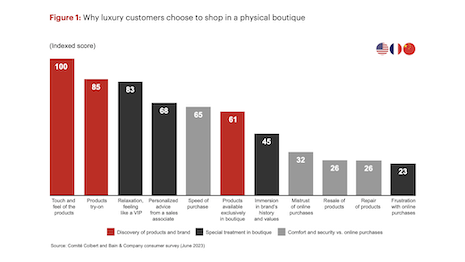
Touch and feel was the most important consideration why luxury customers choose to shop in a physical boutique. Source: Comité Colbert and Bain & Company consumer survey (June 2023)
The accelerated adoption of new technologies in the luxury sector has continued, with increasingly sophisticated use cases for the most mature technologies – notably radio frequency identification and artificial intelligence – and a steady flow of experiments to enhance customer engagement such as augmented or virtual reality and NFTs.
That conclusion comes from a new report, titled “Luxury and Technology: Toward the Boutique of the Future,” produced by Bain & Company for French luxury association Comité Colbert.
“Post-COVID-19, the boutique has reclaimed its status as the cornerstone of a maison’s identity,” said the report’s authors. “However, its role has evolved beyond merely hosting the purchase to providing a human and emotional experience and an immersion in the brand’s universe.”
Interestingly, the metaverse trend has given way to generative artificial intelligence, with highly promising use cases for the luxury business.
Moreover, the connection between new technologies and sustainable development is now much more evident for luxury goods makers, per the report.
Bain and Comité Colbert conducted exclusive qualitative and quantitative surveys of luxury customers in various categories – from ultra-high-net-worth individuals to aspirational customers – covering three core markets (France, United States and China). These surveys enabled the researchers to better understand customers' expectations regarding the boutique’s role and their appetite for a range of technology-supported use cases.
The report was authored by Mathilde Haemmerlé, partner and head of luxury at Bain & Company France; Charlotte Morizot, senior manager in the retail and luxury practice at Bain & Company France; and Joëlle de Montgolfier, executive vice president in the consumer goods, retail and luxury practices at Bain & Company.
Bénédicte Epinay, president/CEO, and Laurent Dhennequin, director of cabinet, both at Comité Colbert, sponsored the report.
Comité Colbert’s members comprise the most prestigious French luxury houses, including several brands from LVMH, Kering and Richemont, as well as Chanel and Hermès.
Bain and Comité Colbert conducted exclusive qualitative and quantitative surveys of luxury customers in various categories (from ultra-high-net-worth individuals to aspirational customers), covering three core markets (France, United States and China). These surveys enabled the researchers to better understand customers' expectations regarding the boutique’s role and their appetite for a range of technology-supported use cases. Source: Bain, Comité Colbert
Engaged experiences
The report’s timing could not be much better as the world bounces back from lockdowns into furious travel and shopping to make up for lost experiences. What it also proves is the enduring appeal of bricks-and-mortar retail shopping and experiences.
Indeed, for 43 percent of luxury customers, discovering the product and the brand is the primary reason for their boutique visit, according to the Bain study. For 34 percent, it is the feeling of VIP treatment.
“That means the boutique must be fully integrated into an omnichannel customer journey,” the Bain report said.
Though often concealed, technology is ubiquitous in boutiques, powering three distinct objectives: magnifying the relationship between customers and sales associates, enriching the discovery of collections and the immersion in the brand’s universe, and, ultimately, streamlining the customer journey and operations.
Seventy-five percent of luxury customers display a strong appetite for the technological use cases tested in the Bain study, assuming the demanding standards of the sector are met: i.e., no self-service and only the highest standards of execution.
The first field of technology application in boutique is about enriching the relationship between the customer and the sales associate.
For 61 percent of luxury shoppers, this relationship influences their willingness to promote a brand, deepening that bond is the main priority for all the surveyed maisons.
Clienteling tools foster intimacy between the customer and the sales associate, enabling more accurate and personalized recommendations based on customer, product and logistics data.
Enhancing the flow of the in-store journey is the second field in which new technologies can be applied, helping to ease existing bottlenecks – 58 percent of customers mention waiting times as a source of frustration.
For instance, tests are performed to enhance the payment stage or the rapid tracking of products in the boutique.
Share of customers citing as first criterion for shopping at a physical boutique. Source: Comité Colbert and Bain & Company consumer survey (June 2023)
Story continues
Beyond these applications, luxury brands are testing use cases aimed at enriching their storytelling: through augmented reality, virtual reality or connected mirrors to breathe extra life into collections and immerse customers in the brand’s universe and heritage.
These experiments are primarily conducted by the maisons affiliated with luxury groups.
Lastly, the combination of luxury market growth and sustainability commitments has made it even more pressing to adopt new technologies and use cases in operations in areas such as boutique-specific assortment selection, improved stock allocation and inventory automation.
NEW TECHNOLOGIES such as artificial intelligence and RFID chips can optimize flows and operations, ultimately maximizing the customer-facing time.
“While new technologies in luxury boutiques have taken significant strides following the COVID pandemic, they still have ample room for development,” the report stated.
“Scaling up their deployment requires a deep transformation of the maisons, extending far beyond the boutique walls. This will involve a cultural revolution (team buy-in, work platforms), a redesign of technological architecture, as well as an evolution of the boutique in terms of its layout and organization.”
Objectives served by technology in the boutique. Share of customers citing as first criterion for shopping at a physical boutique. Source: Comité Colbert and Bain & Company consumer survey (June 2023)
Excerpt from the report:
The customer journey in tomorrow’s boutique
Consider a customer, let’s call her Pamela. She’s Franco-American, works, travels. You all know her: she’s a classic luxury goods shopper. Sometimes she has time, sometimes she doesn’t. She organizes her wish list, schedules an appointment, and checks the availability of that bag she’s been eyeing (which a chatbot has accurately recommended to her, fueled by her browsing history). She might also take a tour of the boutique in advance, using virtual reality or—even better—augmented reality.
Arriving at her destination, she stops in front of the adjacent boutique. Drawn to the interactive displays, she scans a QR code and browses the product details on her phone. She could have joined the virtual line, but it’s already time for her appointment. She enters. The sales associate—seeing her for the first time—already knows her very well. The sales associate has been able to review her purchase history and the Web pages that caught her attention. They know whether to call her Pamela or Mrs. Ferrand. “Oh, please call me Pam,” she interjects, immediately feeling at ease.
She discovers some products she wasn’t familiar with thanks to the sales associate’s app and shares them on her Instagram account. She experiences the latest fashion show as if she had been there. Could she have talked to a robot that might have guided her in this vast flagship boutique? Who knows ... She shows on her phone the details of a bag she had taken a picture of on the streets. The image recognition immediately identifies it.
The products she had selected before coming await her in the fitting room, as well as the products presented by the sales associate (all are in stock because artificial intelligence has brought an unparalleled accuracy to inventory management, aiding restocking through improved demand forecasting, for instance). If she had been in a rush, she could have trusted the hologram or the virtual try-on in augmented reality. But today is all about relaxing so she takes her time, exploring other items, too. Those pumps do indeed go very well with that suit, as suggested by the boutique’s interactive mirror. The tawny leather? No. The beige leather? No. The gray leather? Yes, perfect. In the meantime, the red sweater she spotted when entering the boutique has arrived in black from another store location. A perfume? Why not. She likes cypress, florals, not too sweet, but a bit of sweetness nonetheless—as the neuronal assessment confirms.
Using her phone, she settles her payment directly with the sales associate in the small private lounge where she finishes her very real glass of champagne while her bags are being prepared. She could have also received a payment link, calculated from automatic scans of the radio frequency identification (RFID) chips of her purchases, or been debited directly by passing through the gate at the exit. Euros, dollars, bitcoins? The choice is hers. Artificial intelligence (AI) has allowed prices to be determined based on demand, competition, or stock levels, and to adjust them in real time.
She has already received all the warranty certificates on her account: non-fungible tokens (NFTs) that she can use when she sorts through her wardrobe. She can directly forward the care recommendations to her dry cleaner. She will even be notified when it’s time to nourish the leather of her bag or when the new variation of the perfume she chose comes out. She has the small clutch bag she found for her mother directly delivered to her, and she sends her the video gift card that she recorded on the spot: “Remember? Grandma wore it in blue at my wedding: two generations later, still a customer! Everything changes, yet nothing changes.”
