
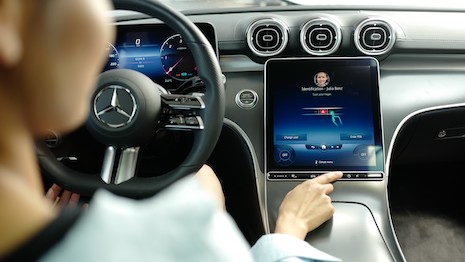
Mercedes-Benz has teamed up with Mastercard to introduce native in-car payments at the fuel pump at participating gas stations by enabling drivers to pay by fingerprint directly in the car with Mercedes pay+. Image credit: Mercedes-Benz
Mercedes-Benz customers in Germany can now fill their tanks directly from their car and pay digitally by fingerprint, thus turning the vehicle into a payment device.
Fingerprint payment authorization at a gas station represents the first use case for native in-car payments at the point of sale (POS), the Stuttgart, Germany-based automaker said. It also makes Mercedes-Benz the world's first automaker to integrate Mastercard's Secure Card on File for Commerce platform into the car.
"With Mercedes pay+, we are making everyday life easier for our customers,” said Franz Reiner, chairman of the board of Mercedes-Benz Mobility AG, in a statement. “From now on, they can pay their fuel bill directly from their car using their fingerprint – simply, securely and conveniently.”
Mercedes-Benz is one of the world's leading luxury car brands.
Fingerprint payment authorization at a gas station represents the first use case for native in-car payments at the point of sale. Image credit: Mercedes-Benz
Card on fuel
Eliminating the need to enter a PIN or authenticate via mobile device, drivers can now leverage payments to improve the in-vehicle experience. Mercedes pay+ can be used to make payments at service stations using the fingerprint sensor integrated into the MBUX infotainment system.
This technology allows for transaction data to be encrypted using uniquely assigned cryptograms, in turn protecting sensitive payment information.
The in-car system is now live with Mastercard debit and credit cards in current Mercedes-Benz models.
Contactless payment via Mercedes me Fuel & Pay and fingerprint sensor is now possible at more than 3,600 participating gas stations in Germany.
Consumers can use their German-issued Mastercard credit or debit cards for native in-car payment by registering their card in the Mercedes me user account and activating it in the vehicle via the MBUX infotainment system Mercedes pay+.
Fingerprint payments from the car will soon be extended to other vehicle-related services and to other European markets.
Contactless payment via Mercedes me Fuel & Pay and fingerprint sensor is now possible at more than 3,600 participating gas stations in Germany. Image credit: Mercedes-Benz
Fill her up
How in-car payment with fingerprint works is simple.
When a driver reaches a connected service station and switches off the engine, the Mercedes me Fuel & Pay service will start automatically on the MBUX infotainment system.
Once started, the driver can simply select the appropriate gas pump. Even before refueling, the system will calculate the maximum total amount based on the current fuel price and the amount of fuel when the tank is full.
Also, rather than authorizing the payment via a mobile device, the driver will complete the transaction seamlessly through fingerprint authentication.
After refueling, the driver will see the amount of fuel refueled and the invoice amount to his or her Mastercard debit or credit cards on the MBUX display.
Payment will be made automatically, and the driver will be able to leave the gas station without having to walk to the checkout area. The invoice is then sent to the customer by email.
"Digital payments are coming of age, and consumers want to embrace new forms that are infused into their everyday experiences and activities,” said Jorn Lambert, chief digital officer of Mastercard, Purchase, New York, in a statement.
A STUDY CONDUCTED by German market researcher GfK on behalf of Mastercard showed that around half of consumers ages 18-39 would order and pay for services and goods directly via the infotainment display.
The proponents would like to use in-car payment primarily for everyday car-related services. Per the survey findings, 60 percent would pay their gas bill or electric vehicle charging directly via the car.
“This joint effort between Mastercard and Mercedes-Benz to enable native in-car payments for fueling is an example of a real-world step towards a more seamless and integrated payments ecosystem that brings together consumer need, the right data and payment credentials to reduce payment friction while retaining payment security,” said Christopher Miller, emerging payments analyst at Javelin, in a statement.
“The announcement highlights the importance of payments experiences that are truly integrated from end-to-end – from authentication hardware in the vehicle, to calculation of fuel costs and needs, to email delivery of receipts,” he said.
“Payment flows that are truly differentiated will persuade consumers to adopt emerging technologies such as pay-by-car. Delivering on these types of experiences requires partners with the capability to coordinate all of these different components into something that is easy for consumers to both use and understand.”
